 |
||
 |
||

 |
• HOME • GENERAL STORE • NATURAL HERITAGE • HISTORY, CULTURE & CRAFTSMANSHIP |
||||
|
Natural Heritage
• Trees & Shrubs of the Ozarks |
|||||
| Trees & Shrubs Index • Oak • Hickory • Walnut • Catalpa • Loblolly Pine • Red cedar • Elderberry • Sumac • Sassafras • Persimmon • Osage-orange • Mulberry • Witch Hazel • Sarvisberry • Dogwood • Redbud • Crape Myrtle • Mimosa Natural Heritage Index • Fishing • Hunting • Camping • Conservation • Bass Pro Blog • Hills & Hollows • Rivers & Lakes • Springs • Caves • Rocks & Fossils • Trees & Shrubs • Plants & Herbs • Hill Critters • Flyin' Critters • Water Critters • Snakes & Such • Forgotten Critters |
|||
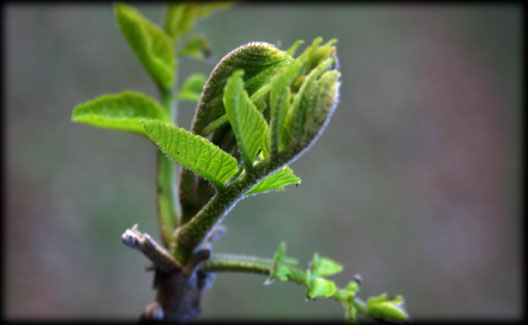
Used to be, walnut-picking was a pretty common tradition wherever the black walnut grows — which is most of the Eastern United States.
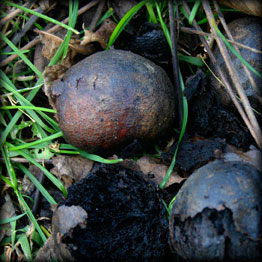
Still, as progress made its way inland, walnut picking has gotten pretty uncommon. These days, lots of folks stand mystified at the husk-encased nuts of this species (plate 4).
And to city folks accustomed to the papery shells of the English walnut (a species native to Persia, whose real name is Juglans regia), black walnuts can be downright disheartening.
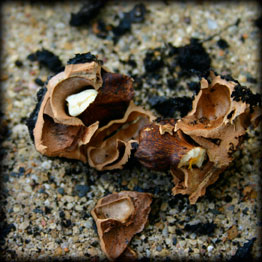
Forget those festive holiday nutcrackers for these puppies. Black walnuts are best discovered through the use of a clean concrete block, a good hammer, and some fast fingers (plate 5).
Remember that the next time you order black walnut ice cream.
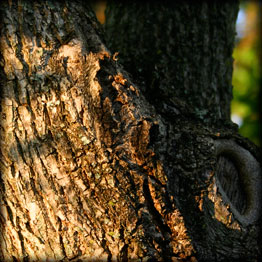
The trees themselves are beautiful, long-lived and comparatively fast-growing. The dense, fine-grained wood is used by many craftsmen for bowls, floors, gunstocks, furniture.
The husks surrounding the nuts themselves can be used as a traditional clothing dye.
A lesser-known sister species to the black walnut is Juglans cinerea, or Butternut. The butternut is a favorite of woodcarvers (the wood is softer than the black walnut but of high quality).
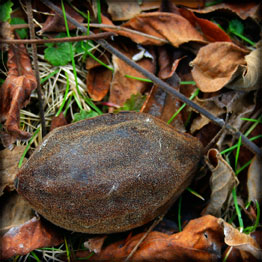
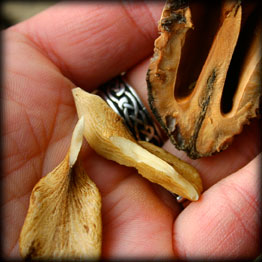
The nut meats are considered by some to be of better flavor than the black walnut — hence its common name (plate 7).
Juglans cinerea is a beautiful, though shorter and more spreading, tree.
Both species, because of their usefulness as a carving wood, lumber, a food source, and as a clothing dye, are deeply integrated into Upper South and Ozarks culture.
— by Joshua Heston
November 16, 2008
________
Black Walnut (Juglans nigra)
Size: 70-90 feet tall; leaves 12-24 inches long.
What to look for: leaves compound, with 15-23 lance-shaped leaflets; terminal leaflet absent or very small; fruits fleshy, yellow-green, with hard black nut inside; twigs with heart-shaped leaf scars and bud in notch (winter).
Habitat: bottomlands and slopes in well-drained soil.
— page 301, Wernett, Susan J., et al. North American Wildlife. The Reader's Digest Association, Inc., 1986.
_______
Butternut (Juglans cinerea)
Size: 40-60 feet tall; leaves 15-30 inches long.
What to look for: leaves compound, with 11-17 lanch-shaped leaflets and hairy stem; terminal leaflet and hairy stem full size; fruits sticky, yellow-green.
Habitat: moist ravines and gentle slopes to dry rocky hillsides.
— page 301, Wernett, Susan J., et al. North American Wildlife. The Reader's Digest Association, Inc., 1986.
From Vance Randolph...
Many hillmen believe that black walnut trees draw lightning and will not go near them in a storm. It is quite common for hillfolk to cut down all the walnuts, even little ones, that grow near their cabins.
— page 72, Ozark Superstitions by Vance Randolph, Columbia University Press 1947
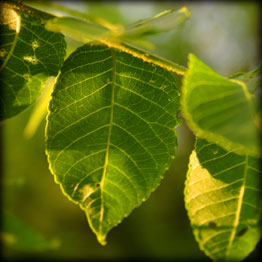
All photo credits: J. Heston • SOTO © Archive.
November 15-16, 2008