Ozark Trees & More
It is impossible to imagine the Ozark hills without trees.
Black walnut picking, hickory nut cake, butternut wood carvings, hedge fence posts, sassafras tea.
Cedar trees for Christmas, catalpas alongside the railroads, pawpaw groves, persimmons turned sweet by the frost.
And spring mountainsides, alive with dogwood and redbud.
Yep. Trees are the heart and soul of these Ozark mountain hills.

Strange tree
- Away beyond the Jarboe house I saw a different kind of tree.
- Its trunk was old and large and bent, And I could feel it look at me.
- The road was going on and on
- Beyond to reach some other place.
- I saw a tree that looked at me, And yet it did not have a face.
- It looked at me with all its limbs; It looked at me with all its bark.
- The yellow wrinkles on its sides
- Were bent and dark.
- And then I ran to get away, But when I stopped and turned to see,
- The tree was bending to the side And leaning out to look at me.
— Elizabeth Madox Roberts
An Ozark Tree List:
White Oak Quercus alba
Sassafras Sassafras albidum
Hickory Carya Illinoensis
Black Walnut Juglans nigra
Butternut Juglans cinerea
Osage Orange Maclura pomifera
Cedar Juniperus virginiana
Dogwood Cornus florida
Persimmon Diospyros virginiana
Catalpa Catalpa bignonioides
Redbud Cercis canadensis
Pawpaw Asinima triloba
White Oak (Quercus alba)
Size: 80-100 feet tall; leaves 5-9 inches long. What to look for: leaves bright green above, pale green below, with 7-9 rounded major lobes (clefts between lobes deep or shallow); acord cup shallow, with knobby scales. Habitat: riverbanks, moist valleys to sandy plains and dry hillsides.
— page 306, Wernett, Susan J., et al. North American Wildlife. The Reader's Digest Association, Inc., 1986.

Plate 1. A row of colorful sweetgum trees (Liquidambar styraciflua) line the spot where Riverside Inn once stoof. Christian County, Missouri. October 21, 2012.

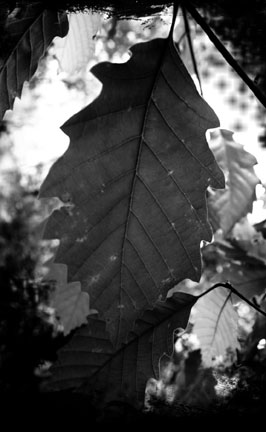
Plate 2. A whorl of oak leaves (Quercus sp.) silhouette the sky.

Plate 3. Hopeful green sassafras (Sassafras albidum) reach for the sun.

Plate 4. Bountiful cedar berries (Juniperaceae sp.) wait for hungry cedar waxwings to descend.

Plate 6. Tender black walnut leave (Juglans nigra) are illuminated by last light of a fading day.
...cold November days
by Joshua Heston
A friend’s photo caught my eye the other day. It was of southbound Highway 65 as a cold gray sky soared overhead. Altocumulus clouds reigned over a landscape turned decidedly brown.
Nothin’ special.
Nonetheless, it is still a favorite time for me. The rash of fall colors — yellow hickory, red sumac and rust oak, orange sassafras — has been washed away like so much confetti. In some ways, it is almost a relief. The beauty of a striking autumn brings with it a sense of tension: as though one strong breath will make it all blow away.
No, there is that sense of relief when the leaves are gone and the beauty is of a more subtle sort. Frost and fog on the mountaintops. A purple sky at twilight. Cedars, dark and green and fragrant in the glades. Were it not for the bustle of the holiday season, it could be a quiet time of reflection, hopefully of a season well lived.
— from November 20, 2011 State of the Ozarks Weekly Issue 210